A Professional's Take on the New K70 Pro Mini Wireless
The compact mechanical keyboard market continues to evolve, and the K70 Pro Mini Wireless arrives at a time when buyers increasingly value portability, low-latency wireless performance, and desktop-grade build quality in a smaller footprint. This review examines the K70 Pro Mini Wireless from the perspective of professionals who use keyboards for mixed workloads—programming, content creation, remote meetings, and competitive gaming—evaluating design, feel, connectivity, battery management, customization options, and real-world suitability.
Introduction: Why compact wireless keyboards matter
Full-size keyboards remain relevant, but many professionals and enthusiasts prefer compact layouts to free desk space, improve ergonomics (shorter reach to the mouse), and simplify travel. A modern compact keyboard needs to do more than shrink — it must deliver precise typing, reliable wireless connectivity, easy customization, and durability comparable to larger models. The K70 Pro Mini Wireless aims to meet these expectations while preserving premium touches found on higher-end keyboards.
Detailed product review and analysis
Design and build quality
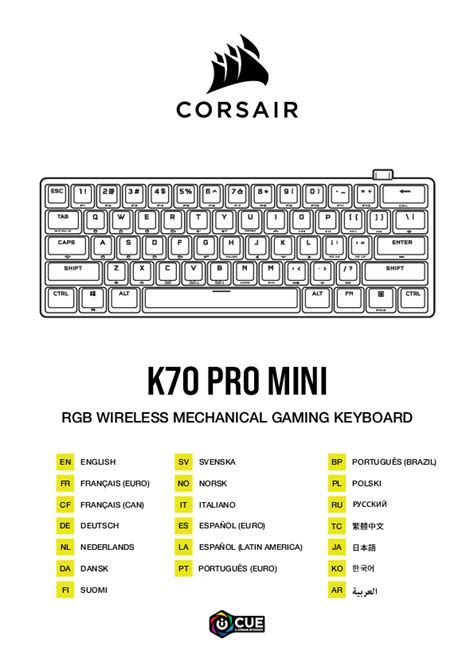
The K70 Pro Mini Wireless presents a premium aesthetic that suits both minimalist office setups and RGB-accented gaming rigs. The keyboard uses a compact layout—commonly a 65% or similar condensed form factor—removing the numpad and, in many cases, the dedicated function row while retaining essential navigation keys. Build materials and finishing are important to professionals; the K70 Pro Mini Wireless typically emphasizes a metal top plate or reinforced frame for rigidity, combined with textured plastic on the lower case to keep weight reasonable for travel.
Keycap quality and profile influence both feel and longevity. The K70 Pro Mini Wireless is usually offered with PBT or higher-quality ABS keycaps depending on the market variant. Legends, profile (e.g., OEM, Cherry, or similar), and thickness affect typing acoustics and comfort. From a serviceability perspective, look for accessible stabilizers, removable feet, and a user-friendly case disassembly for maintenance.
Switch options and typing characteristics
Switch choice is a principal decision for buyers. The K70 Pro Mini Wireless is sold with a variety of mechanical switch options—linear, tactile, and clicky—suitable for different workflows. Professionals who prioritize quiet reliability (open-plan offices, video calls) typically choose tactile or quiet linear switches, while typists and gamers who want distinct feedback may prefer tactile options.
Hot-swap support is a notable feature in this segment. If present, it allows users to try different switches without soldering, making the keyboard adaptable over its lifespan. Stabilizer tuning (lubing, clipping) can dramatically improve longer key feel (spacebar, enter), and factory-prepared stabilizers vary in quality. Expect improved experience from properly tuned stabilizers out of the box or acceptability for minor post-purchase mods by enthusiasts.
Connectivity, latency, and modes
One of the main selling points of the K70 Pro Mini Wireless is multi-mode connectivity. The keyboard typically supports Bluetooth (useful for multi-device workflows), 2.4 GHz wireless (for the lowest practical latency), and wired USB-C for charging or direct connection. For gaming and latency-sensitive work, the 2.4 GHz mode—often using a dedicated USB receiver—provides near-wired responsiveness. Bluetooth remains convenient for laptops, tablets, and phones, where long battery life and ease of switching between devices matter.
Latency performance is critical for competitive gamers and any professional relying on high-speed input. The K70 Pro Mini Wireless positions itself to minimize latency in 2.4 GHz mode while providing good responsiveness in Bluetooth mode for general productivity. Users should test both modes with their specific hardware and operating systems; results can vary based on receiver placement, RF interference, and host device drivers.
Battery life and power management
Battery life in compact wireless keyboards balances physical size, battery capacity, LED usage, and the chosen wireless mode. With RGB disabled and in Bluetooth mode, typical battery life for compact wireless mechanical keyboards can stretch multiple days to a few weeks depending on use; enabling per-key RGB, frequent macros, and 2.4 GHz use will reduce that substantially. The K70 Pro Mini Wireless is designed with practical power-management features—sleep timers, adjustable LED brightness, and quick-charge via USB-C—to keep interruptions to a minimum during workdays and travel.
Professionals should note charging ergonomics: a detachable USB-C cable that doubles as a tether for wired use is valuable, as is the ability to use the keyboard while charging without noticeable input lag or charging heat issues.
Software, customization, and onboard memory
Software ecosystems determine the real-world flexibility of a keyboard. The K70 Pro Mini Wireless typically offers a companion application for remapping keys, setting macros, and customizing RGB profiles. Onboard memory for saving profiles is important for people who move between multiple computers or need a consistent layout for tournaments and shared workstations.
Find top-rated Electronics products at great prices.
Browse Now →For professionals concerned with privacy and corporate IT policies, the availability of basic remapping via hardware shortcuts (without vendor software) is a plus. It reduces the need to install third-party software and ensures consistent behavior across environments where admin rights may be restricted.
Acoustics and ergonomics
Typing sound affects the suitability of a keyboard for different environments. The K70 Pro Mini Wireless aims for a balanced acoustic signature—clear but not intrusive. Foam dampening inside the case or a gasket mount can reduce hollowness and improve tactile feel; knowledge of whether the keyboard uses a gasket, tray, or plate-mount construction helps buyers anticipate noise profile and travel comfort.
Ergonomics includes tilt, compact layout layout-friendly arrow/navigation key placement, and keycap sculpting. The reduced reach to the mouse from a compact board can improve wrist posture for many users. Professionals who spend long hours typing should combine the keyboard with a proper wrist rest and monitor setup to reduce strain.
Real-world use cases
Office professional: The K70 Pro Mini Wireless suits hybrid office workers who move between desk and meeting room with a laptop. Bluetooth multi-host switching and good battery management make it easy to pair with both a laptop and a phone. Quiet switch variants and lower RGB brightness are preferable in shared environments.
Remote worker and traveler: For those who travel frequently, the keyboard’s compact size and detachable cable are clear benefits. The weight and case durability matter in luggage; a reinforced frame reduces wobble when typing on imperfect surfaces such as airplane tray tables.
Gamer and creator: Competitive players will prioritize the 2.4 GHz receiver and low-latency switches; creators (video/audio editors, art professionals) appreciate programmable macro layers and reliable key rollover for complex shortcuts.
Hybrid setups: Developers and power users who use multiple devices and operating systems benefit from multi-mode connectivity and onboard profiles that preserve custom layouts across environments.
Pros & Cons
- Pros
- Compact footprint frees desk space and shortens mouse reach for improved ergonomics
- Multi-mode wireless (Bluetooth + 2.4 GHz) accommodates both convenience and low-latency needs
- Premium build materials and reinforced frame for desktop-grade feel
- Customizability through switch options, software, and onboard memory
- Detachable USB-C cable and practical power-management features
- Cons
- Smaller layout reduces immediate access to dedicated keys (numpad, function row) — requires relearning or layer use
- Battery life can be significantly shorter with per-key RGB enabled and in 2.4 GHz mode
- High-end variants may be priced above budget compact keyboards
- Software ecosystem and driver support may vary by platform—macOS and Linux users should verify compatibility
Comparison: How the K70 Pro Mini Wireless stacks up
The following table gives a concise comparison against two representative compact wireless mechanical keyboards that buyers often consider in the same segment. Specifications are generalized; buyers should verify exact model details and options before purchase.
| Attribute | K70 Pro Mini Wireless | Keychron K6 (representative) | Logitech compact wireless (representative) |
|---|---|---|---|
| Layout | Compact 65%/similar | 65% / 68-key options | TKL or compact low-profile |
| Wireless modes | Bluetooth + 2.4 GHz + Wired (USB-C) | Bluetooth + Wired (USB-C); some models with 2.4 GHz | Bluetooth + Lightspeed/2.4 GHz + Wired |
| Hot-swap support | Varies by SKU — check specific model | Some SKUs support hot-swap | Often not hot-swap (proprietary low-profile designs) |
| Customization & software | Companion software + onboard profiles | Basic software + firmware updates; strong community resources | Robust software with ecosystem integrations |
| Target user | Hybrid professional / gamer seeking premium compact wireless | Value-focused enthusiasts / multi-device users | Users wanting low-profile, polished wireless experience |
| Price (approx.) | Mid-to-high range (depends on switches and features) | Budget-to-mid range | Mid-to-high range (often premium) |
Buying guide: How to decide if the K70 Pro Mini Wireless is right
When evaluating the K70 Pro Mini Wireless and similar compact wireless keyboards, professionals should consider the following factors:
1. Intended use and workflow
Define primary workflows: prolonged typing, fast-paced gaming, or frequent device switching. Prioritize low-latency 2.4 GHz for competitive gaming; for multi-device office work, value robust Bluetooth multi-host functionality and onboard profiles that persist without software.
Discover deals on Electronics — updated daily.
Shop Amazon →2. Switch type and typing profile
Choose switch types based on environment and preference: tactile for balanced feedback, linear for smooth actuation (often favored in gaming), clicky for audible feedback (not recommended for shared spaces). If available, hot-swap models let the buyer experiment without soldering.
3. Layout trade-offs
Compact layouts save space but require layer keys for functions like F-keys and numpad input. Ensure the keyboard’s default layer mappings suit common tasks (e.g., copy/paste, media controls). Professionals who need a numpad daily will prefer a dedicated numpad or a full-size layout.
4. Battery expectations
Estimate real-world battery life based on intended LED and wireless use. If the buyer uses frequent RGB effects, expect shorter battery lifespans. For road warriors, prioritize models with fast charging and the ability to operate while charging.
5. Software and cross-platform support
Confirm that the keyboard’s companion software supports the buyer’s operating system. For macOS and Linux users, check for native support or reliable community drivers. Hardware remapping options are valuable when software cannot be installed on corporate machines.
6. Build quality and maintenance
Look for durable cases, quality keycaps (PBT preferred), and stable stabilizers. Check whether the keyboard is user-serviceable—removable feet, swappable keycaps, and accessible screws simplify repairs and mods, which lengthen the product’s usable life.
7. Portability vs. desktop permanence
Decide whether the keyboard will be transported frequently. Travel-focused buyers should prefer lighter models with protective cases or reinforced frames. For permanent desktop use, heavier metal plates and gasket mounts can improve typing feel at the expense of portability.
8. Warranty and ecosystem
Confirm warranty lengths and what they cover (switches, electronics, physical damage). Consider the vendor’s ecosystem—replacement keycap sets, accessories like wrist rests, and community engagement can boost long-term enjoyment and value.
Practical tips before buying
- Try switches in person if possible; switch preference is highly personal. Keyboard showrooms or meetups are useful for testing.
- Check if the keyboard supports firmware updates and whether they are easy to apply. Firmware updates often add stability and features.
- If working in a shared space, consider quieter switch variants and lower RGB settings to avoid distracting colleagues.
- Plan for desk layout changes: a compact keyboard shifts mouse placement; measure space to ensure comfort.
- Read multiple user reports for battery life and wireless reliability rather than relying on a single benchmark; real-world performance varies.
Conclusion
The K70 Pro Mini Wireless attempts to bridge professional productivity and enthusiast-level customization in a compact wireless form factor. For those who value desk space, multi-device workflows, and a premium typing feel, it represents a compelling option—especially when configured with quiet or tactile switches and conservative LED settings for everyday use. Competitive gamers who prioritize the lowest possible latency will benefit from testing the 2.4 GHz mode in their specific environment.
As with any keyboard purchase, the right choice depends on individual priorities: switch preference, layout convenience, software needs, and tolerance for battery trade-offs. The K70 Pro Mini Wireless is well-positioned for hybrid users who demand a portable, refined typing experience without sacrificing the responsiveness and customization expected from higher-end models. Evaluating the keyboard against the practical buying guide points above will help buyers determine whether it meets their professional needs and daily workflows.